Listen to this article in summarized format
×
Subscribe to 
Unlock AI Briefing and Premium Content
New Year Offer 24 Hours Left
Subscribe NowAlready a member? Sign In
What's Included
- Exclusive Stories
- Daily ePaper Access
- Smart Market Tools
- Curated Investment Ideas
- Ad-lite Experience
Subscription

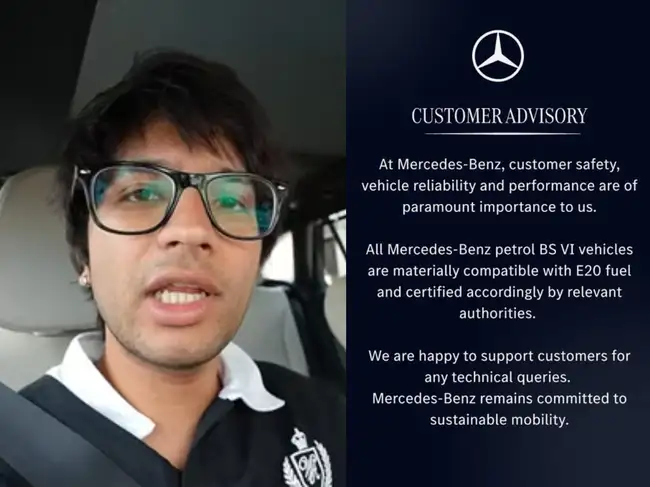
Mercedes-Benz India has clarified that all its BS VI petrol vehicles are fully compatible with E20 petrol, days after popular YouTuber Sourav Joshi claimed that the fuel efficiency of his Mercedes-Benz SUV had dropped dramatically after using ethanol-blended petrol.
The luxury carmaker issued the clarification through its official social media channels, stating that its BS VI petrol models have been certified for E20 fuel by the relevant authorities. Although the company did not mention Joshi by name, the advisory came shortly after his video discussing the issue went viral.
What did Sourav Joshi claim?
In a recent YouTube vlog, Sourav Joshi said the mileage of his Mercedes-Benz SUV had fallen sharply over two days.
Speaking in the video, he said: "Yesterday I showed you our car's mileage had gone from 17 straight down to 9. And do you know what it has become today? Today it has reached five... look at this, it's showing a mileage of five."
Joshi claimed the issue was linked to ethanol-blended petrol available at local fuel stations.
"This is what has happened because of ethanol," he said.
He also claimed that after refuelling, the vehicle's estimated driving range had reduced from around 800 kilometres to 480 kilometres.
Expressing concern about the long-term impact on the vehicle, Joshi added: "I don't know when this car will break down... Nowadays I'm so scared of refilling petrol."
The YouTuber also mentioned that he owns an electric Mercedes-Benz G-Class (G-Wagon), which he said frees him from concerns surrounding ethanol-blended fuel.
Mercedes-Benz India issues clarification on E20 compatibility
Following the widespread attention generated by the video, Mercedes-Benz India released a customer advisory addressing concerns surrounding E20 petrol.
The company stated: "At Mercedes-Benz, customer safety, vehicle reliability and performance are of paramount importance to us. All Mercedes-Benz petrol BS VI vehicles are materially compatible with E20 fuel and certified accordingly by relevant authorities."
The company further added: "We are happy to support customers for any technical queries. Mercedes-Benz remains committed to sustainable mobility."
The advisory reiterates that Mercedes-Benz BS VI petrol vehicles are designed to operate using E20 fuel in accordance with regulatory standards.
What is E20 petrol?
E20 petrol is a blend consisting of:
The Indian government has promoted ethanol-blended fuel as part of its strategy to reduce dependence on imported crude oil, lower carbon emissions and support domestic ethanol production.
Why has E20 fuel sparked debate?
Despite its environmental and economic objectives, E20 petrol has remained a subject of discussion among vehicle owners.
Some motorists have expressed concerns about:
Government defends ethanol-blended petrol programme
Amid ongoing concerns over mileage and engine performance, the government recently defended its ethanol-blending initiative.
According to the government, the programme has:
Officials have maintained that the policy delivers significant economic and environmental benefits while encouraging vehicle manufacturers to produce engines compatible with higher ethanol blends.
Inputs from agencies
(You can now subscribe to our Economic Times WhatsApp channel)
The luxury carmaker issued the clarification through its official social media channels, stating that its BS VI petrol models have been certified for E20 fuel by the relevant authorities. Although the company did not mention Joshi by name, the advisory came shortly after his video discussing the issue went viral.
What did Sourav Joshi claim?
In a recent YouTube vlog, Sourav Joshi said the mileage of his Mercedes-Benz SUV had fallen sharply over two days.Speaking in the video, he said: "Yesterday I showed you our car's mileage had gone from 17 straight down to 9. And do you know what it has become today? Today it has reached five... look at this, it's showing a mileage of five."

Joshi claimed the issue was linked to ethanol-blended petrol available at local fuel stations.
"This is what has happened because of ethanol," he said.
He also claimed that after refuelling, the vehicle's estimated driving range had reduced from around 800 kilometres to 480 kilometres.
Expressing concern about the long-term impact on the vehicle, Joshi added: "I don't know when this car will break down... Nowadays I'm so scared of refilling petrol."
The YouTuber also mentioned that he owns an electric Mercedes-Benz G-Class (G-Wagon), which he said frees him from concerns surrounding ethanol-blended fuel.
Mercedes-Benz India issues clarification on E20 compatibility
Following the widespread attention generated by the video, Mercedes-Benz India released a customer advisory addressing concerns surrounding E20 petrol.The company stated: "At Mercedes-Benz, customer safety, vehicle reliability and performance are of paramount importance to us. All Mercedes-Benz petrol BS VI vehicles are materially compatible with E20 fuel and certified accordingly by relevant authorities."
The company further added: "We are happy to support customers for any technical queries. Mercedes-Benz remains committed to sustainable mobility."
The advisory reiterates that Mercedes-Benz BS VI petrol vehicles are designed to operate using E20 fuel in accordance with regulatory standards.
What is E20 petrol?
E20 petrol is a blend consisting of:- 20% ethanol
- 80% petrol
The Indian government has promoted ethanol-blended fuel as part of its strategy to reduce dependence on imported crude oil, lower carbon emissions and support domestic ethanol production.
Why has E20 fuel sparked debate?
Despite its environmental and economic objectives, E20 petrol has remained a subject of discussion among vehicle owners.Some motorists have expressed concerns about:
- Reduced fuel efficiency
- Possible effects on older petrol engines
- Long-term maintenance costs for vehicles not designed for higher ethanol blends
Government defends ethanol-blended petrol programme
Amid ongoing concerns over mileage and engine performance, the government recently defended its ethanol-blending initiative.According to the government, the programme has:
- Helped strengthen India's sugar economy
- Increased farmers' incomes
- Saved the country more than Rs 1.90 lakh crore in foreign exchange since 2014–15
Officials have maintained that the policy delivers significant economic and environmental benefits while encouraging vehicle manufacturers to produce engines compatible with higher ethanol blends.
Inputs from agencies
Add  as a Reliable and Trusted News Source
as a Reliable and Trusted News Source Add Now!
 (You can now subscribe to our Economic Times WhatsApp channel)