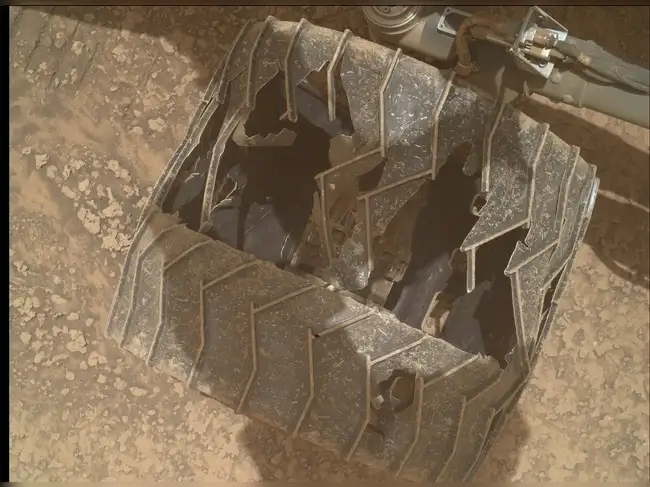
A close-up image from NASA’s Curiosity Mars rover has revealed the extreme circumstances the machine has endured after nearly 14 years of driving across one of the harshest landscapes humans have explored. The image, captured by Curiosity’s Mars Hand Lens Imager (MAHLI) camera on July 23, 2026, shows one of the rover’s metal wheels marked by deep cracks, dents and damaged sections, according to Space.com.
The worn wheel is not just a sign of aging hardware, it is a visual record of years of exploration, showing the challenges involved in operating a machine millions of kilometres away from Earth.
NASA’s Curiosity rover landed inside Gale Crater on August 6, 2012, after completing a dramatic “sky crane” landing sequence that lowered the one-ton spacecraft onto the Martian surface.
Built by NASA’s Jet Propulsion Laboratory (JPL), Curiosity was designed for a planned mission of just one Martian year (about 687 Earth days). More than a decade later, it continues to operate and has travelled over 20 miles (32 kilometres) across Mars.
During that journey, its aluminium wheels have faced sharp rocks, uneven terrain and repeated impacts that would be impossible to repair from Earth. NASA has previously acknowledged that the wheels have experienced significant wear but said they remain functional.
In a 2024 update, NASA engineers noted that Curiosity’s wheels were “holding up well” despite taking some of the harshest punishment on Mars, reported Space.com.
Mars is not a smooth desert. The planet’s surface is filled with rocky terrain that can damage even carefully engineered equipment. Curiosity’s six wheels are made from lightweight aluminium and feature specially designed treads called grousers, which provide traction on loose Martian soil.
However, early in the mission, engineers discovered that sharp rocks were creating punctures and cracks in the wheels, especially while travelling through areas with rough terrain.
Unlike a normal vehicle on Earth, Curiosity cannot simply replace a damaged tyre or visit a repair station. Every design decision had to account for years of exposure without human assistance.
NASA engineers later adjusted Curiosity’s driving strategies, including choosing routes with less damaging terrain and carefully monitoring wheel health.
Curiosity carries multiple cameras and scientific instruments that allow engineers on Earth to inspect the rover. The recent wheel images were captured using the Mars Hand Lens Imager (MAHLI), a high-resolution camera located at the end of Curiosity’s robotic arm.
MAHLI was primarily designed to examine rocks, soil and geological features, but it is also used to photograph parts of the rover itself, including its wheels.
Curiosity has transformed scientists’ understanding of Mars by discovering evidence that Gale Crater once contained conditions that could have supported microbial life billions of years ago.
Among its major discoveries, the rover has found:
There is no fixed retirement date for Curiosity. The rover’s original mission was extended multiple times because its instruments and power system continued working.
Curiosity is powered by a radioisotope power system (RTG), which generates electricity from the natural decay of plutonium-238. This allows it to operate through Martian winters and dust storms, unlike solar-powered spacecraft that depend on sunlight.
However, engineers continue monitoring ageing components, including wheels, instruments and mechanical systems.
The worn wheel is not just a sign of aging hardware, it is a visual record of years of exploration, showing the challenges involved in operating a machine millions of kilometres away from Earth.
Curiosity rover’s battered wheels tell the story of 14 years on Mars
NASA’s Curiosity rover landed inside Gale Crater on August 6, 2012, after completing a dramatic “sky crane” landing sequence that lowered the one-ton spacecraft onto the Martian surface.
Built by NASA’s Jet Propulsion Laboratory (JPL), Curiosity was designed for a planned mission of just one Martian year (about 687 Earth days). More than a decade later, it continues to operate and has travelled over 20 miles (32 kilometres) across Mars.

During that journey, its aluminium wheels have faced sharp rocks, uneven terrain and repeated impacts that would be impossible to repair from Earth. NASA has previously acknowledged that the wheels have experienced significant wear but said they remain functional.
In a 2024 update, NASA engineers noted that Curiosity’s wheels were “holding up well” despite taking some of the harshest punishment on Mars, reported Space.com.
Why are Curiosity’s wheels cracking?
Mars is not a smooth desert. The planet’s surface is filled with rocky terrain that can damage even carefully engineered equipment. Curiosity’s six wheels are made from lightweight aluminium and feature specially designed treads called grousers, which provide traction on loose Martian soil.
However, early in the mission, engineers discovered that sharp rocks were creating punctures and cracks in the wheels, especially while travelling through areas with rough terrain.
Unlike a normal vehicle on Earth, Curiosity cannot simply replace a damaged tyre or visit a repair station. Every design decision had to account for years of exposure without human assistance.
NASA engineers later adjusted Curiosity’s driving strategies, including choosing routes with less damaging terrain and carefully monitoring wheel health.
How NASA checks the rover’s condition from millions of kilometres away
Curiosity carries multiple cameras and scientific instruments that allow engineers on Earth to inspect the rover. The recent wheel images were captured using the Mars Hand Lens Imager (MAHLI), a high-resolution camera located at the end of Curiosity’s robotic arm.
MAHLI was primarily designed to examine rocks, soil and geological features, but it is also used to photograph parts of the rover itself, including its wheels.
Curiosity has transformed scientists’ understanding of Mars by discovering evidence that Gale Crater once contained conditions that could have supported microbial life billions of years ago.
Among its major discoveries, the rover has found:
- ancient river and lake deposits,
- organic molecules in Martian rocks,
- evidence of past environments with water,
- changes in Mars’ climate over geological time.
How long can Curiosity continue operating?
There is no fixed retirement date for Curiosity. The rover’s original mission was extended multiple times because its instruments and power system continued working.
Curiosity is powered by a radioisotope power system (RTG), which generates electricity from the natural decay of plutonium-238. This allows it to operate through Martian winters and dust storms, unlike solar-powered spacecraft that depend on sunlight.
However, engineers continue monitoring ageing components, including wheels, instruments and mechanical systems.
Add  as a Reliable and Trusted News Source
as a Reliable and Trusted News Source Add Now!