Listen to this article in summarized format
×
Subscribe to 
Unlock AI Briefing and Premium Content
New Year Offer 24 Hours Left
Subscribe NowAlready a member? Sign In
What's Included
- Exclusive Stories
- Daily ePaper Access
- Smart Market Tools
- Curated Investment Ideas
- Ad-lite Experience
Subscription

 TIL Creatives
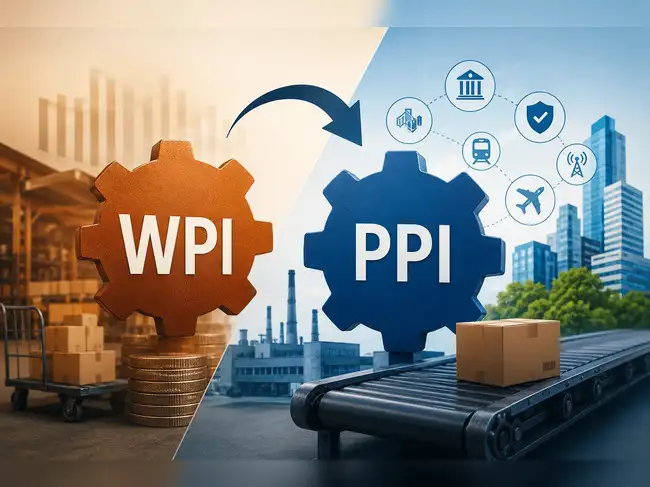
The government has kicked off the retirement of the Wholesale Price Index (WPI), rolling out India's first set of Producer Price Index (PPI) data on June 15 and setting a five-year transition period before WPI is discontinued, according to a press release issued by the Ministry of Commerce and Industry.
The change, more than two decades in the making, will eventually require businesses to rethink how they price and index contracts. "Businesses should not wait until the formal replacement of WPI by PPI to reassess their contractual frameworks," said DK Srivastava, Chief Policy Advisor, EY India.
Also read: India introduces PPI for goods and services, begins shift from WPI
To put it simply: consider a packet of biscuits. The PPI is the price the factory receives at the point of production. The WPI tracks its price a step later, when it enters bulk wholesale trading. The CPI, further down the line, is what you finally pay at the retail shop.
The Ministry says PPI has three components:
Alongside launching PPI, the Ministry also revised WPI's base year to 2022-23 from 2011-12 and expanded its basket from 697 to 957 items, according to the official release.
Solar, wind and nuclear power have been added under electricity, and crude petroleum and natural gas have been moved from "primary articles" to "fuel and power" for cleaner classification.
The missing piece, according to the government, has always been the price at the factory gate: what producers themselves receive or pay for goods and services. PPI is designed to fill that gap.
The WPI framework also excludes the services sector, even though services now account for more than half of India's economy.
The government has said the shift brings India in line with the practice followed by advanced economies such as the US, UK, EU, Japan and China, and with methodology recommended by the International Monetary Fund (IMF).
The transition matters most for contracts. The Ministry notes that WPI is currently the reference point for indexation, cost escalation and contract pricing across industries, directly affecting cash flows, tariff revisions and risk-sharing between parties. That is why the five-year transition window exists.
Srivastava added that businesses should use this window to compare both indices and begin recalibrating escalation clauses, particularly in new and long-term contracts. Key risks flagged during the transition include possible mismatches between WPI and PPI trends, friction in renegotiating existing contracts, and the need for reliable historical benchmarks.
PPI's role also extends beyond inflation tracking. It has already begun feeding into the Index of Industrial Production (IIP), and the government is preparing to use it to deflate nominal output while estimating real GDP, with a revised back-series expected in August.
Also read: Govt to replace WPI with Producer Price Index for future procurement contracts
According to Dipti Deshpande, Principal Economist, Crisil, WPI and CPI are currently both used to deflate prices for GDP estimation, and PPI, being a closer measure of producer-level prices, is expected to take over that role over time.
Input PPI remains on a trial basis for now. The Ministry has said this is deliberate, meant to test data quality and gather feedback from stakeholders before it becomes a full, policy-grade index, meaning that further refinements in coverage and methodology are likely as more data becomes available.
(You can now subscribe to our Economic Times WhatsApp channel)
The change, more than two decades in the making, will eventually require businesses to rethink how they price and index contracts. "Businesses should not wait until the formal replacement of WPI by PPI to reassess their contractual frameworks," said DK Srivastava, Chief Policy Advisor, EY India.
Also read: India introduces PPI for goods and services, begins shift from WPI
What is WPI, and what is PPI?
According to the Ministry's official release, the WPI measures price changes for goods at the wholesale stage. PPI, meanwhile, measures prices received by producers at the point of production, before wholesale margins and taxes are added.To put it simply: consider a packet of biscuits. The PPI is the price the factory receives at the point of production. The WPI tracks its price a step later, when it enters bulk wholesale trading. The CPI, further down the line, is what you finally pay at the retail shop.

The Ministry says PPI has three components:
- Output PPI (OPPI): The prices producers receive for their output.
- Input PPI (IPPI): The prices producers pay for inputs, currently limited to manufacturing, and released on a trial basis.
- Service PPI (SPPI): Prices for services, starting with seven sectors, banking, securities transactions, insurance, pension fund management, railways, air passenger transport and telecom.
Alongside launching PPI, the Ministry also revised WPI's base year to 2022-23 from 2011-12 and expanded its basket from 697 to 957 items, according to the official release.
Solar, wind and nuclear power have been added under electricity, and crude petroleum and natural gas have been moved from "primary articles" to "fuel and power" for cleaner classification.
Why is WPI being replaced?
India has long relied on two indices to track inflation: WPI, which measures prices at the wholesale stage, and the Consumer Price Index (CPI), which measures what consumers pay.The missing piece, according to the government, has always been the price at the factory gate: what producers themselves receive or pay for goods and services. PPI is designed to fill that gap.
The WPI framework also excludes the services sector, even though services now account for more than half of India's economy.
The government has said the shift brings India in line with the practice followed by advanced economies such as the US, UK, EU, Japan and China, and with methodology recommended by the International Monetary Fund (IMF).
What are the implications, and what changes?
PPI is not replacing WPI overnight. According to the release, both indices will run in parallel for five years before WPI is discontinued, giving businesses and government departments time to adjust.The transition matters most for contracts. The Ministry notes that WPI is currently the reference point for indexation, cost escalation and contract pricing across industries, directly affecting cash flows, tariff revisions and risk-sharing between parties. That is why the five-year transition window exists.
Srivastava added that businesses should use this window to compare both indices and begin recalibrating escalation clauses, particularly in new and long-term contracts. Key risks flagged during the transition include possible mismatches between WPI and PPI trends, friction in renegotiating existing contracts, and the need for reliable historical benchmarks.
PPI's role also extends beyond inflation tracking. It has already begun feeding into the Index of Industrial Production (IIP), and the government is preparing to use it to deflate nominal output while estimating real GDP, with a revised back-series expected in August.
Also read: Govt to replace WPI with Producer Price Index for future procurement contracts
According to Dipti Deshpande, Principal Economist, Crisil, WPI and CPI are currently both used to deflate prices for GDP estimation, and PPI, being a closer measure of producer-level prices, is expected to take over that role over time.
Input PPI remains on a trial basis for now. The Ministry has said this is deliberate, meant to test data quality and gather feedback from stakeholders before it becomes a full, policy-grade index, meaning that further refinements in coverage and methodology are likely as more data becomes available.
Add  as a Reliable and Trusted News Source
as a Reliable and Trusted News Source Add Now!
 (You can now subscribe to our Economic Times WhatsApp channel)