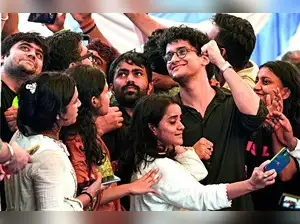
New Delhi: "Get Ready With Me to Get Beaten Up by the Police." "So bad, even the privileged are here!" "Kuchu puchu, tum kahan ho? Please resign kar do." "Police uncle: Ek danda laga do!" A parody of the hit Punjabi song Dil Luteya, rewritten as Desh Luteya. Protesters dressed as giant cockroaches. Videos of police chasing students edited to the soundtrack of Subway Surfers.
A week ago, these may have sounded like unrelated internet memes. Today, they are among the most shared moments from the student protests that spilled from Delhi's Jantar Mantar onto Instagram Reels and YouTube Shorts, turning social media into one of the movement's biggest stages.
At Jantar Mantar, phones are almost as common as placards. Students record, film slogans, sit on pavements editing videos and finding ways to upload them amid internet shutdowns and patchy connectivity. Every chant, parody, and confrontation is captioned and shared almost instantly. For years, endless scrolling has been blamed for shrinking attention spans, particularly among Gen Z.
The protests, however, present an interesting contrast. Instead of watching a 20-minute speech or a lengthy political debate, many young people are stitching together the movement through multiple short videos. The attention span may be shorter, but the curiosity has simply shifted to a different format.
"People haven't stopped paying attention," said Smita Upadhyaya, a Delhi-based behavioural researcher. "They've changed the way they pay attention. Instead of investing 20 minutes in one video, they consume the same issue through multiple short pieces of content. Those pieces add up to a much richer understanding than we often assume." Humour is often the hook. A parody song, a witty placard or a satirical skit makes people stop scrolling. The explanation comes next.
One reel explains why students demanded education minister Dharmendra Pradhan's resignation. Another captures conversations from the protest site. Others document journeys of students travelling from different parts of the country to Delhi. Individually, each clip offers only a glimpse. Together, they help viewers understand what the movement is about.
"Our generation lives on Instagram," said Aashita Agrawal, a 21-year-old student participating in the protest.
(You can now subscribe to our Economic Times WhatsApp channel)
A week ago, these may have sounded like unrelated internet memes. Today, they are among the most shared moments from the student protests that spilled from Delhi's Jantar Mantar onto Instagram Reels and YouTube Shorts, turning social media into one of the movement's biggest stages.
At Jantar Mantar, phones are almost as common as placards. Students record, film slogans, sit on pavements editing videos and finding ways to upload them amid internet shutdowns and patchy connectivity. Every chant, parody, and confrontation is captioned and shared almost instantly. For years, endless scrolling has been blamed for shrinking attention spans, particularly among Gen Z.
The protests, however, present an interesting contrast. Instead of watching a 20-minute speech or a lengthy political debate, many young people are stitching together the movement through multiple short videos. The attention span may be shorter, but the curiosity has simply shifted to a different format.
"People haven't stopped paying attention," said Smita Upadhyaya, a Delhi-based behavioural researcher. "They've changed the way they pay attention. Instead of investing 20 minutes in one video, they consume the same issue through multiple short pieces of content. Those pieces add up to a much richer understanding than we often assume." Humour is often the hook. A parody song, a witty placard or a satirical skit makes people stop scrolling. The explanation comes next.

One reel explains why students demanded education minister Dharmendra Pradhan's resignation. Another captures conversations from the protest site. Others document journeys of students travelling from different parts of the country to Delhi. Individually, each clip offers only a glimpse. Together, they help viewers understand what the movement is about.
"Our generation lives on Instagram," said Aashita Agrawal, a 21-year-old student participating in the protest.
Add  as a Reliable and Trusted News Source
as a Reliable and Trusted News Source Add Now!
 (You can now subscribe to our Economic Times WhatsApp channel)