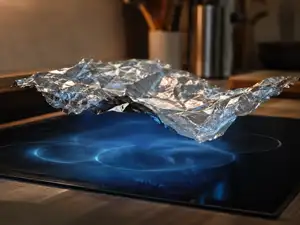
No, it's not a trick. It's physics. Image Credits: ChatGPT
If you’ve ever accidentally dropped a piece of aluminum foil onto an induction cooktop, you might have seen something strange. The foil doesn't just sit there. It jumps, wiggles, and even lifts right off the surface sometimes as if it has a mind of its own. According to a report from the tech and engineering outlet Hackaday, this everyday kitchen oddity was turned into a levitation trick using a regular induction stove and some foil. It feels like magic, but it isn't. It's basic physics, and it explains something a lot of Americans encounter every time they wrap up leftovers before heating them.
Wait, isn't foil supposed to be magnet-proof? This is the part that trips people up. Aluminum is not magnetic. There's a reason you can't stick a fridge magnet to a soda can. Induction cooktops are built to work best with magnetic, or "ferromagnetic," cookware like cast iron or certain stainless steel pans. So foil should just sit there quietly, doing nothing.
Except it doesn't. According to the University of Central Florida’s physics textbook chapter on eddy currents, an induction cooktop works by passing a rapidly flipping magnetic field through a coil under the glass surface. Any conductive metal you put above that coil, magnetic or not, will be pushed by small looping electric currents. These are known as eddy currents. Aluminum foil is thin, but it still conducts electricity well, so those currents appear in it as well.
The cooktop doesn't check if metal is magnetic; it checks how it reacts to the field. Image Credits: ChatGPT
Why does the sensor get fooled Every induction cooktop has a built-in check to make sure that it won’t turn on if it doesn’t sense the right cookware. That check should fail for aluminum foil, in theory. But the Iowa State University resource on eddy current testing says alternating current in a conductor does not distribute evenly. It crowds near the surface, an effect called the “skin effect.” Because foil is basically all surface and almost no depth, it behaves electrically like a much thicker sheet of metal at the cooktop's operating frequency. That's enough to trick the sensor into thinking it's a real pan.
So why does the foil float? If there is a current flowing in the foil, it makes its own tiny magnetic field. Physics has a rule about what happens next, known as Lenz's law: the new magnetic field will always push back against the one that created it. That resistance is precisely what allows things like aluminum discs to hover over spinning magnets in classroom demonstrations, as seen in the eddy current levitation demonstration from Harvard's Department of Physics. That same repelling force also shows up as a slight upward push on the pieces of foil closest to the coil of an induction cooktop. Magnetism isn’t pulling the foil. It is moving away from the magnetic field of the cooktop as its own induced current is opposing it.
Live Events
Melting, not just floating The bits of foil that stay close to the coil don’t just float; they heat up fast. For a few seconds, the same current that produces the push is also generating heat due to electrical resistance. The foil is so thin that this can be enough to scorch or melt it in a matter of seconds, which is consistent with burn marks that home cooks have reported after accidentally leaving foil on their stovetops.
Levitation and heat, both from the same invisible force. Image Credits: ChatGPT
A fun explanation, not a kitchen hack None of this makes foil a safe thing to use on your induction stove. In fact, the safety warning in the cooktop owner’s manual warns users not to cook with foil on the glass as it can melt and damage the surface. Appliance makers across the US also issue similar warnings, as foil can spark, overheat, or stress the coil beneath the glass.
The best part about the viral demo is that it answers something many home cooks have wondered quietly about after seeing foil twitch on their stovetop. The “magic” turns out to be a combination of eddy currents, the skin effect and Lenz’s law, three concepts from a college physics class playing out right on your kitchen counter.
So the next time your foil starts dancing, you’ll know exactly what’s going on. This is not levitation in the sci-fi sense. It's just electromagnetism doing what it always does, just somewhere you did not expect to see it.


 as a Reliable and Trusted News Source
 Add Now!