 ET Online
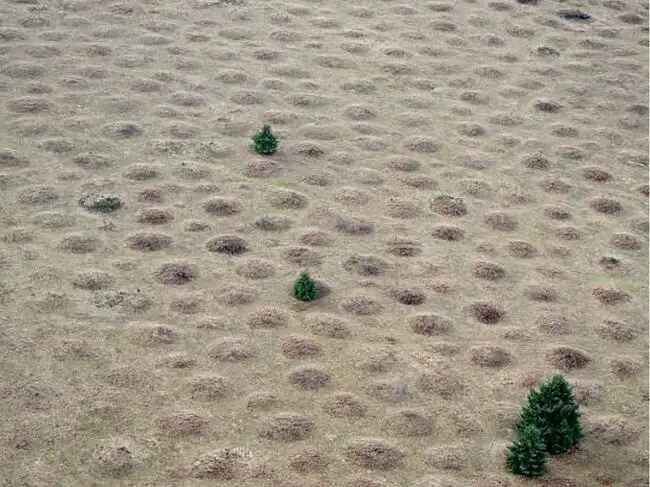
What’s the secret behind the mounds? Oval, almost dome shaped, they do provide quite a memorable sight. Even after centuries of research, a question mark still lingers upon their origins. The Mima Mounds Natural Area Preserve in Washington State is home to hundreds of rounded earthen mounds scattered across a vast prairie between Mount Rainier and Mount St. Helens.
Rising between two and seven feet above the surrounding landscape and stretching up to 40 feet in diameter, these unusual formations create a distinctive rolling terrain. Despite decades of research, scientists have yet to determine exactly how the mounds were formed. Their striking appearance and unexplained origin have made the Mima Mounds one of the world's most fascinating geological enigmas, attracting researchers and visitors eager to understand the processes behind this remarkable natural phenomenon.
According to a National Geographic report, scientists have not yet been able to unearth the origins behind these mima mounds or soil pimples.
In an interview with National Geographic, Regina Johnson, an assistant natural areas ecologist with the Washington Department of Natural Resources, shared several theories to their origins. Some attribute these mounds to natural causes such as earthquakes and floods, while some researchers think, these mounds were created by gophers, a type of rodents.
Since explorers first documented the Mima mounds in the Pacific Northwest during the mid-19th century, their origin has puzzled scientists. One of the earliest explanations came in 1913 from geologist J. Harlan Bretz, who later became famous for identifying the forces that created Eastern Washington's Channeled Scablands. Bretz proposed that the mounds were remnants of ancient snow and ice formations known as suncups. According to his theory, shallow depressions in melting snow gradually trapped layers of sediment over time. As the ice disappeared, these accumulated deposits were left behind as rounded mounds of earth and rock, creating the distinctive landscape seen today. Although influential at the time, this hypothesis is now considered just one of many competing theories seeking to explain the mysterious formation of the Mima mounds.
In 1940, R. C. Newcomb of the U.S. Geological Survey, theorised that the mounds were caused by polygons - where ice fills cracks in frozen earth and melts consequently, leaving behind hollows in the soil.
According to an article published by the Geological Society of America, one of the more recent explanations for the origin of the Mima mounds was proposed by Washington State geologist Andrew Berg in 1990. Berg suggested that powerful earthquakes caused loose surface sediments to shift and accumulate into localized piles, eventually giving rise to the distinctive mounds.
While this idea has not been extensively expanded or validated through subsequent scientific research, it has gained support among some geologists in the Pacific Northwest. The hypothesis is particularly appealing to researchers who study the region's active seismic landscape and volcanic activity, both of which are closely linked to the Cascadia Subduction Zone, an area known for generating major earthquakes and shaping the region's geology.
While the question mark on the origins of these mounds remains, the existence of these mounds make these areas a quaint place to visit.
Rising between two and seven feet above the surrounding landscape and stretching up to 40 feet in diameter, these unusual formations create a distinctive rolling terrain. Despite decades of research, scientists have yet to determine exactly how the mounds were formed. Their striking appearance and unexplained origin have made the Mima Mounds one of the world's most fascinating geological enigmas, attracting researchers and visitors eager to understand the processes behind this remarkable natural phenomenon.
According to a National Geographic report, scientists have not yet been able to unearth the origins behind these mima mounds or soil pimples.
In an interview with National Geographic, Regina Johnson, an assistant natural areas ecologist with the Washington Department of Natural Resources, shared several theories to their origins. Some attribute these mounds to natural causes such as earthquakes and floods, while some researchers think, these mounds were created by gophers, a type of rodents.
Since explorers first documented the Mima mounds in the Pacific Northwest during the mid-19th century, their origin has puzzled scientists. One of the earliest explanations came in 1913 from geologist J. Harlan Bretz, who later became famous for identifying the forces that created Eastern Washington's Channeled Scablands. Bretz proposed that the mounds were remnants of ancient snow and ice formations known as suncups. According to his theory, shallow depressions in melting snow gradually trapped layers of sediment over time. As the ice disappeared, these accumulated deposits were left behind as rounded mounds of earth and rock, creating the distinctive landscape seen today. Although influential at the time, this hypothesis is now considered just one of many competing theories seeking to explain the mysterious formation of the Mima mounds.
In 1940, R. C. Newcomb of the U.S. Geological Survey, theorised that the mounds were caused by polygons - where ice fills cracks in frozen earth and melts consequently, leaving behind hollows in the soil.
According to an article published by the Geological Society of America, one of the more recent explanations for the origin of the Mima mounds was proposed by Washington State geologist Andrew Berg in 1990. Berg suggested that powerful earthquakes caused loose surface sediments to shift and accumulate into localized piles, eventually giving rise to the distinctive mounds.
While this idea has not been extensively expanded or validated through subsequent scientific research, it has gained support among some geologists in the Pacific Northwest. The hypothesis is particularly appealing to researchers who study the region's active seismic landscape and volcanic activity, both of which are closely linked to the Cascadia Subduction Zone, an area known for generating major earthquakes and shaping the region's geology.
While the question mark on the origins of these mounds remains, the existence of these mounds make these areas a quaint place to visit.
Add  as a Reliable and Trusted News Source
as a Reliable and Trusted News Source Add Now!
 (Catch all the Business News, Breaking News, and Latest News Updates on The Economic Times.)
Subscribe to The Economic Times Prime and read the ET ePaper online.
Read More News on
(Catch all the Business News, Breaking News, and Latest News Updates on The Economic Times.)
Subscribe to The Economic Times Prime and read the ET ePaper online.