One wrap, several signals blocked. Image Credits: ChatGPT
Scroll through TikTok long enough, and you might see it: somebody wrapping their wallet in a piece of kitchen foil like it is a burrito. It sounds like a joke until you look at what is actually sitting inside most American wallets. It’s more than just a credit card. According to the ACLU of Washington, the unique ID number on an Enhanced Driver's License can be read with standard commercial RFID readers up to 162 feet away, or the width of a football field. That’s a documented concern from a civil liberties group that pushed for state laws constraining this sort of scanning. So before you dismiss the foil trend as paranoia, it’s worth knowing exactly what is being broadcast and from where.
Why wireless theft is a real concern Contactless chips are now found in many everyday items. Government IDs, transit passes, and workplace badges all rely on some form of RFID or NFC technology to operate quickly at checkpoints, turnstiles, and doors. That convenience is real, and so is the tradeoff. The ACLU reports that RFID tags on Enhanced Driver’s Licenses were flagged as insecure, and adds that DHS itself had acknowledged the chips could be read from as far as 30 feet away, and cites a security researcher who assembled a reader from about $250 in spare parts and drove around downtown San Francisco to show the cards could be skimmed and copied without the owner noticing. It also argues that the licenses omit basic protections found in U.S. passports and smart chip credit cards.
To be clear, this is not the same as someone emptying a bank account from across a subway platform. The vast majority of these chips carry a reference number, not personal details, and normally require equipment most people will probably never encounter. The bigger concern is not a dramatic one-off theft but quiet repeated tracking, because a chip can transmit the same fixed number wherever a person goes.
The chip in your wallet doesn't need contact to be read. Image Credits: ChatGPT
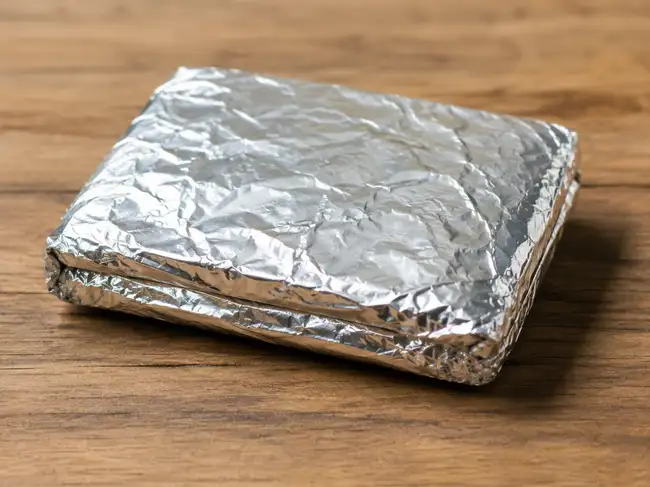
Does foil actually work This is where the basic physics is. Aluminum is a conductor, and conductors block or scatter radio waves. It's the same principle that works with a Faraday cage, a sealed metal container that blocks signals from entering or leaving. The metals used in RFID-blocking wallets, such as copper or aluminum, block emitted RFID radio signals without damaging the card or document itself, according to Norton.
But it does have its flaws. Aluminum foil can be effective at blocking RFID tags, but it tears easily and has thin spots that allow some signal through, so several tight layers are better than one loose wrap. It works best when it covers the whole wallet, which matters more now that wallets often hold several wirelessly readable items, not just one card.
Live Events
Your driver's license might be one of them Enhanced Driver’s Licenses are only available in five states: Washington, Michigan, Minnesota, New York and Vermont. They let residents cross land and sea borders into Canada and Mexico, and enter by sea from Bermuda and the Caribbean, without a passport, using a long-range RFID chip that border agents can read before a driver even reaches the checkpoint. The Department of Homeland Security says no personally identifiable information is stored on the chip itself, but a unique ID number linked to a secure federal database.
That has not fully settled the concern. Privacy advocates continue to call for more stringent protections because an EDL’s identifying number can still be read from up to two feet away, even inside the protective foil sleeve the card comes in.
A simple foil sleeve is the low-tech fix issued alongside every passport card. Image Credits: ChatGPT
Your passport card is an even bigger signal The risk is higher if a person carries a US passport card instead of the full passport book. AFAR notes that the range of a radio-frequency receiver reading passport cards is much larger than that of a typical contactless card, with the ability to read the passport from up to 25 feet away. That’s why the State Department ships every passport card in its own sleeve. Remove that sleeve, and the card is effectively broadcasting from across a room.
Transit passes and work badges count too Reloadable transit cards and most office or campus access badges run on the same underlying technology. They are not usually subject to theft like a payment card, as they carry no direct value. But they remain wireless-readable items in the same wallet, meaning the same shielding logic applies to them as it does to a license or a passport card.
The bigger habit shift The real point is not about the foil specifically. It is that a typical American wallet now holds more items that can be read wirelessly than most people think: a license, a passport card, a transit pass, a badge, credit cards, sometimes all five. To think of the wallet as one unit worth protecting is a more realistic way to think about the problem than worrying about a single card. If foil sounds like too much of a hassle, a Faraday sleeve or RFID-blocking wallet provides the same coverage and is built to last longer.


 as a Reliable and Trusted News Source
 Add Now!