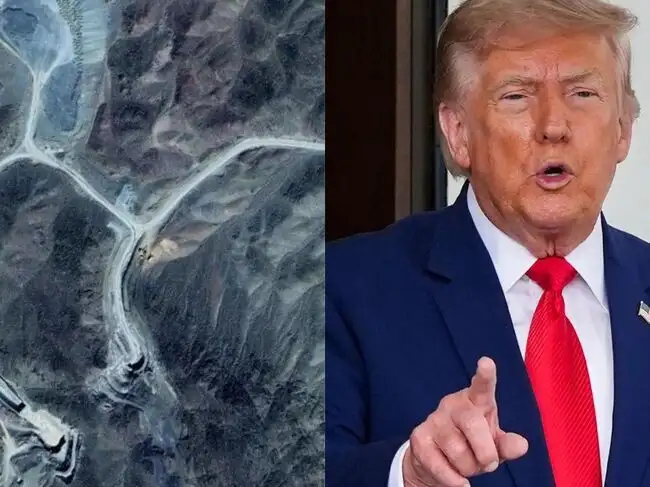
Pickaxe Mountain, a heavily fortified mountain site linked to Iran’s nuclear infrastructure, has come under renewed spotlight after US President Donald Trump said in a recent interview that the United States could target the area “pretty soon.” The site lies near Iran’s Natanz nuclear complex, one of the country’s most important uranium enrichment centers. Security analysts and nuclear experts consider Pickaxe Mountain one of the most protected locations linked to Iran’s nuclear program because key facilities are believed to be buried deep inside the mountain.
The mountain has become a focus of attention because of extensive underground construction carried out beneath its rocky terrain. According to assessments by the Institute for Science and International Security, work on the underground facility began around late 2020. Iran said at the time that the new underground halls were intended to replace an above-ground advanced centrifuge assembly facility at Natanz that had previously been destroyed.
Natanz has long been at the center of international concern over Iran’s nuclear program. The enrichment site has been targeted in military operations over the years. However, according to expert assessments, the newer tunnel complex beneath Pickaxe Mountain was not struck during recent conflicts involving Iran, Israel and the United States.
What makes the Pickaxe Mountain site significant?
What distinguishes Pickaxe Mountain from many other nuclear-related facilities is the depth and protection of its underground structures. Expert analysis by the think-tank indicates that the site contains two sets of tunnel entrances carved into the mountain. These entrances are believed to provide access to a large underground complex. Analysts estimate that parts of the facility may lie more than 100 meters beneath the mountain’s surface, making it one of the deepest known nuclear-linked installations in Iran. The mountain itself rises to about 1,608 meters above sea level.
Experts believe the depth of the facility was deliberately chosen to provide protection from air strikes and conventional bunker-busting weapons. The think-tank's experts believe that if Iran rebuilds its centrifuge manufacturing network, it could establish a smaller centrifuge assembly facility inside Pickaxe Mountain to support a potential nuclear weapons program. The vast underground complex is thought to have enough space not only for centrifuge production but also for a uranium enrichment plant capable of producing weapons-grade uranium, it said.
Donald Trump's challenge
The think-tank's analysts say the site presents a major challenge for any attacker. According to assessments cited by the Institute for Science and International Security, the underground complex may be beyond the reach of even the most powerful bunker-buster bombs currently available in the U.S. arsenal.
Because of its depth and fortification, experts argue that ground-based attacks could be more effective than conventional aerial bombardment.
Rising tensions
The focus on Pickaxe Mountain comes amid renewed tensions between Washington and Tehran. Following Trump’s comments about the site, Iran’s Khatem al-Anbiya Central Headquarters, the country’s top joint military command, warned that any U.S. strike on Iranian nuclear facilities would trigger retaliation against American interests and those of its allies.
Why is it called Pickaxe Mountain?
According to Institute for Science and International Security (ISIS), a Washington-based non-proliferation research organization, the name “Pickaxe Mountain” comes from the Persian name of the mountain, Kuh-e Kolang Gaz La. The word “Kolang” translates to “pickaxe”, leading researchers and analysts to refer to the location as Pickaxe Mountain in English-language reports.The mountain has become a focus of attention because of extensive underground construction carried out beneath its rocky terrain. According to assessments by the Institute for Science and International Security, work on the underground facility began around late 2020. Iran said at the time that the new underground halls were intended to replace an above-ground advanced centrifuge assembly facility at Natanz that had previously been destroyed.
Location of Pickaxe Mountain
Pickaxe Mountain is situated roughly 220 kilometers south of Tehran and about 2 kilometers from the Natanz nuclear complex. The area forms part of a larger secured zone that includes multiple underground installations associated with Iran’s nuclear activities, according to the think-tank.Natanz has long been at the center of international concern over Iran’s nuclear program. The enrichment site has been targeted in military operations over the years. However, according to expert assessments, the newer tunnel complex beneath Pickaxe Mountain was not struck during recent conflicts involving Iran, Israel and the United States.
What makes the Pickaxe Mountain site significant?
What distinguishes Pickaxe Mountain from many other nuclear-related facilities is the depth and protection of its underground structures. Expert analysis by the think-tank indicates that the site contains two sets of tunnel entrances carved into the mountain. These entrances are believed to provide access to a large underground complex. Analysts estimate that parts of the facility may lie more than 100 meters beneath the mountain’s surface, making it one of the deepest known nuclear-linked installations in Iran. The mountain itself rises to about 1,608 meters above sea level. Experts believe the depth of the facility was deliberately chosen to provide protection from air strikes and conventional bunker-busting weapons. The think-tank's experts believe that if Iran rebuilds its centrifuge manufacturing network, it could establish a smaller centrifuge assembly facility inside Pickaxe Mountain to support a potential nuclear weapons program. The vast underground complex is thought to have enough space not only for centrifuge production but also for a uranium enrichment plant capable of producing weapons-grade uranium, it said.
Donald Trump's challenge
The think-tank's analysts say the site presents a major challenge for any attacker. According to assessments cited by the Institute for Science and International Security, the underground complex may be beyond the reach of even the most powerful bunker-buster bombs currently available in the U.S. arsenal.Because of its depth and fortification, experts argue that ground-based attacks could be more effective than conventional aerial bombardment.
Rising tensions
The focus on Pickaxe Mountain comes amid renewed tensions between Washington and Tehran. Following Trump’s comments about the site, Iran’s Khatem al-Anbiya Central Headquarters, the country’s top joint military command, warned that any U.S. strike on Iranian nuclear facilities would trigger retaliation against American interests and those of its allies.Add  as a Reliable and Trusted News Source
as a Reliable and Trusted News Source Add Now!
 (Catch all the Business News, Breaking News, and Latest News Updates on The Economic Times.)
Subscribe to The Economic Times Prime and read the ET ePaper online.
(Catch all the Business News, Breaking News, and Latest News Updates on The Economic Times.)
Subscribe to The Economic Times Prime and read the ET ePaper online.