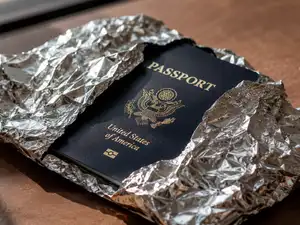
Is wrapping your passport in foil actually smart, or just a TikTok trend? Image Credits: ChatGPT
If you have scrolled through travel content online lately, you may have spotted someone wrapping their passport in aluminum foil before a flight. It looks funny, almost like a conspiracy habit. Butaccording to the study, ‘Security and Privacy Issues in E-passports,’ by security researchers Ari Juels, David Molnar, and David Wagner, the trick is tied to a real feature of how electronic passports work.
Biometric passports have a chip, which contains the photo and personal data of the owner, and the foil is supposed to prevent someone nearby reading the chip. If you have one of these chip-embedded passports, it is worth knowing what is really going on.
What is inside a US passport chip US e-passports have a small RFID chip embedded in the back cover of the booklet, close to the spine, according toreporting on e-passportengineering. The chip is passive, meaning it has no battery of its own. It only turns on when a reader in the vicinity transmits a radio signal, causing it to return the data printed on the photo page, including the traveler’s name, date of birth, passport number, and a digital copy of the photo.
This chip, according to the study by Juels and colleagues, uses the ISO 14443 standard and has a target read range of about 10 centimeters, or about 4 inches, with a regular authorized reader.
The small gold symbol on the cover indicates an embedded RFID chip. Image Credits: ChatGPT
Why aluminum foil actually works here The idea behind the foil trick is a Faraday cage. A Faraday cage is an enclosure made of a conductive material like metal that blocks electromagnetic signals from getting in or out. According to the study by Juels and colleagues, wrapping your passport like this creates a barrier that makes it harder for an RFID reader to communicate with the chip, reducing the chance that someone could access data such as your name, photo, or date of birth in a crowded airport or train station. The same Faraday cage principle is the standard countermeasure researchers cite for blocking what’s known as clandestine scanning, an unauthorized read done without the passport holder’s knowledge.
Live Events
But foil is not the sturdiest fix This is the part many viral posts leave out. The study argues that a Faraday cage will work only if the conductive layer fully encloses the chip without gaps or openings. Household foil is thin, easily crinkles, and can rip or move out of place after a few uses. This means a hurried or incomplete wrap could leave a corner of the passport exposed and unprotected. Instead, travellers often use purpose-built RFID-blocking sleeves that are designed to keep that seal intact, trip after trip. The same style of sleeve can also be used for contactless bank cards.
Your passport may already be shielded Foil may also be less necessary than it seems. Separate from Faraday-cage travel hacks, U.S. e-passports were already built with their own defense:reporting on the2005 federal e-passport rule by Government Executive describes a woven metal mesh inlay in the front cover and part of the back cover, designed to block radio transmissions to the chip whenever the booklet is closed. In other words, a similar shielding layer may already be built into the cover of your passport.
RFID-blocking sleeves are a sturdier alternative to the foil hack. Image Credits: ChatGPT
What foil cannot protect you from Being realistic about the limits helps too. This study says that a Faraday cage, whether it’s foil or built-in mesh, only prevents reads if the passport is closed. Once it is opened and scanned at a check-in counter or border kiosk, the shielding is gone. Protection then depends on the encryption used between the chip and the reader, and not on any wrapping.
Skip the tape and glue If you want to try this, do not use tape, glue, or anything else that might damage the passport cover itself. According to the report by Government Technology, US passport officials say it is a criminal offense to alter a passport's chip, even without fraudulent intent, and doing so can carry penalties, regardless of whether the passport itself still functions afterward. A safer version of this habit is to simply slip the passport into a pouch or sleeve, as RFID-blocking sleeves offer the same Faraday cage effect without touching the document.
What it means for US travelers The foil trick is no myth, and it’s no groundless warning either. It works because of real, well-studied radio physics, the same physics your passport’s own manufacturers are already building into the cover. For most travelers with a current US e-passport, the built-in shielding will probably be doing most of the work. If you want to take an extra step just to be extra careful, especially with an older passport, a cheap RFID-blocking sleeve, or even just a careful foil wrap, is a low-effort way to keep your data a little more private while you are moving through a crowded terminal.


 as a Reliable and Trusted News Source
 Add Now!